The Door Stone of American Liberty
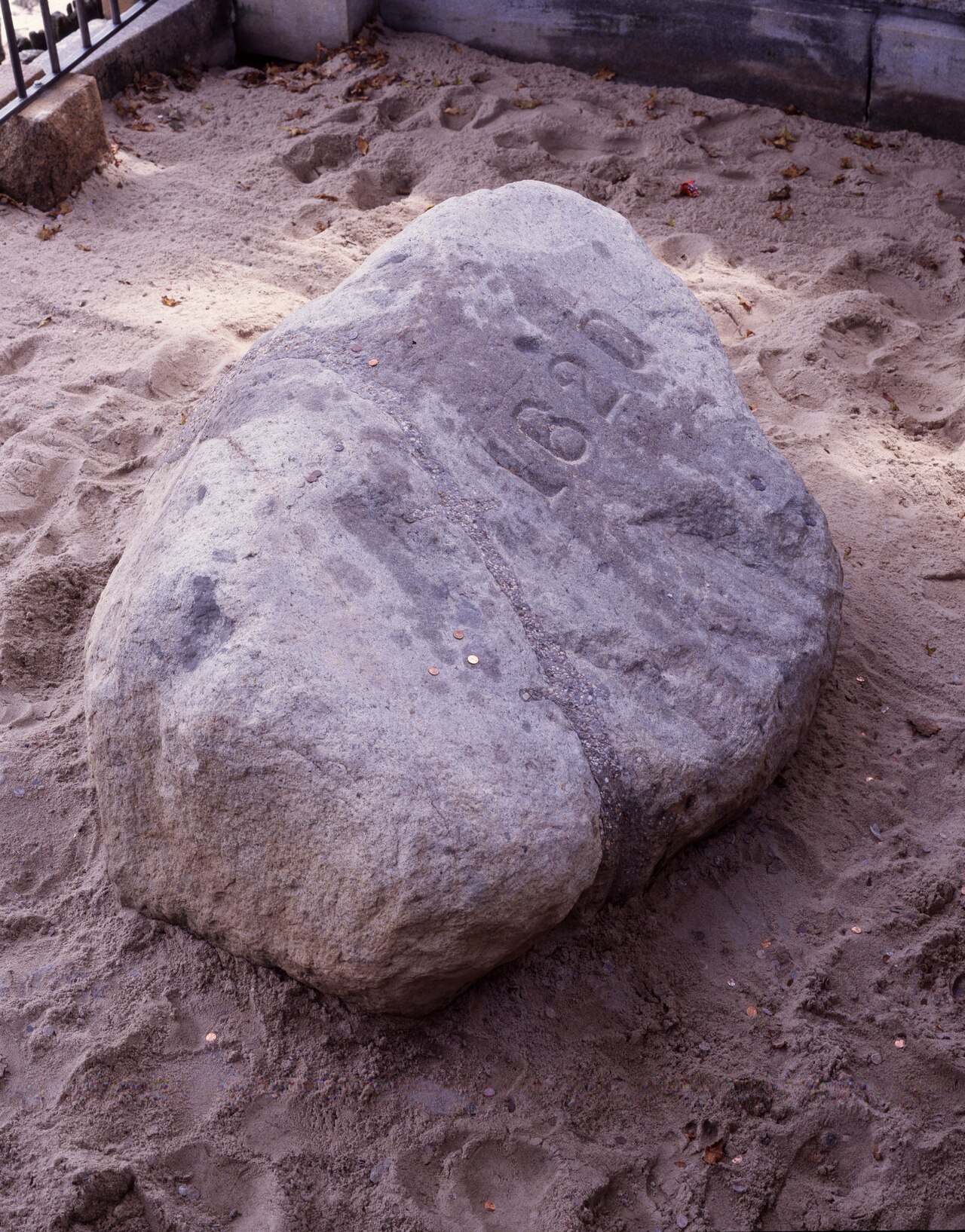
Neither eyewitness account of the 1620 landing mentions a rock. One turned up 121 years later, and Plymouth hasn't stopped moving it since.
Neither of the two eyewitness accounts of the Pilgrims' 1620 landing mentions a rock. William Bradford and the authors of Mourt's Relation, as Pilgrim Hall Museum puts it, "simply say that the Pilgrims landed." The rock enters the story 121 years later, in 1741, when Plymouth planned to build a wharf over a big boulder at the foot of Cole's Hill.
That's when Thomas Faunce, 94 or 95 depending on who's counting, had himself carried three miles to the shore in a chair. His father, who came over in 1623 on the Anne, three years after the Mayflower, had told him this was the one that "received the footsteps of our fathers." A crowd watched the old man say goodbye to it, and according to an 1835 town history he "bedewed it with his tears."
In 1774 the town decided its rock deserved a better spot. Colonel Theophilus Cotton and a crowd with about thirty yoke of oxen raised it with screws, and it "split asunder, without any violence." With a revolution coming, that was read as an omen: the British Empire would split too. They left the bottom half at the shore and hauled the top up to the liberty pole in Town Square.
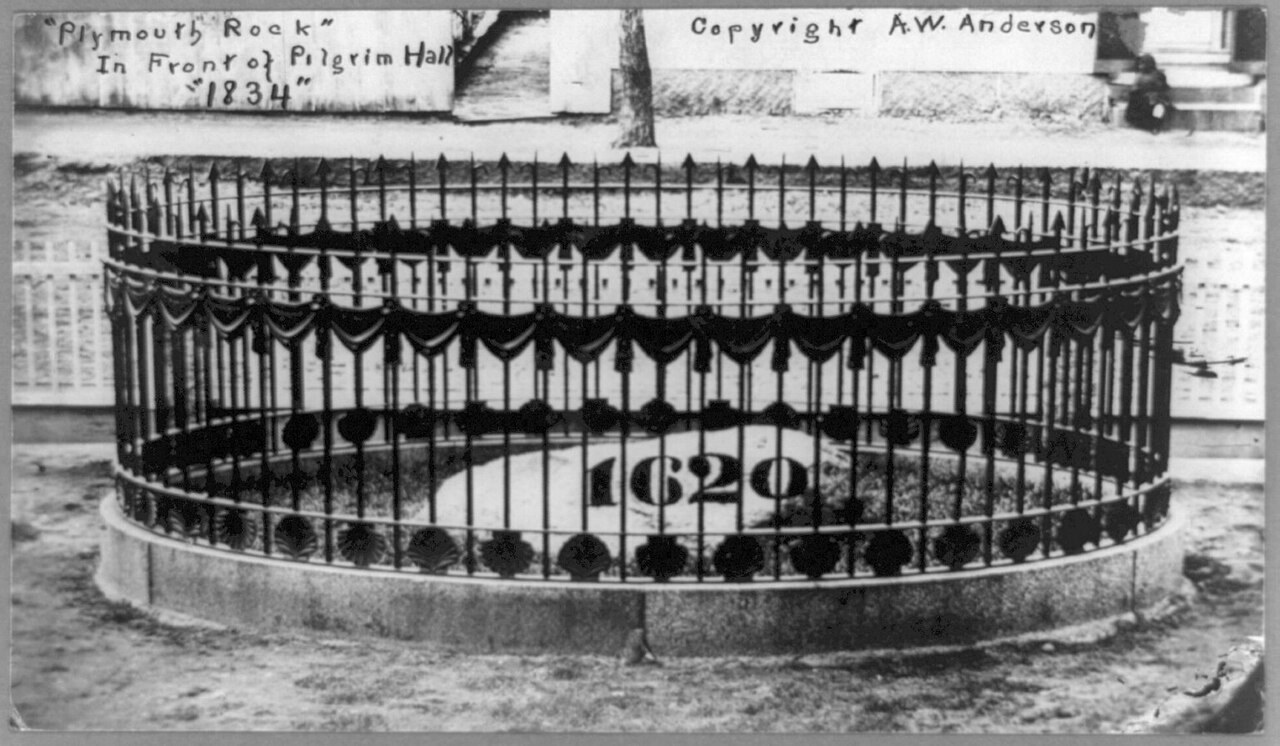
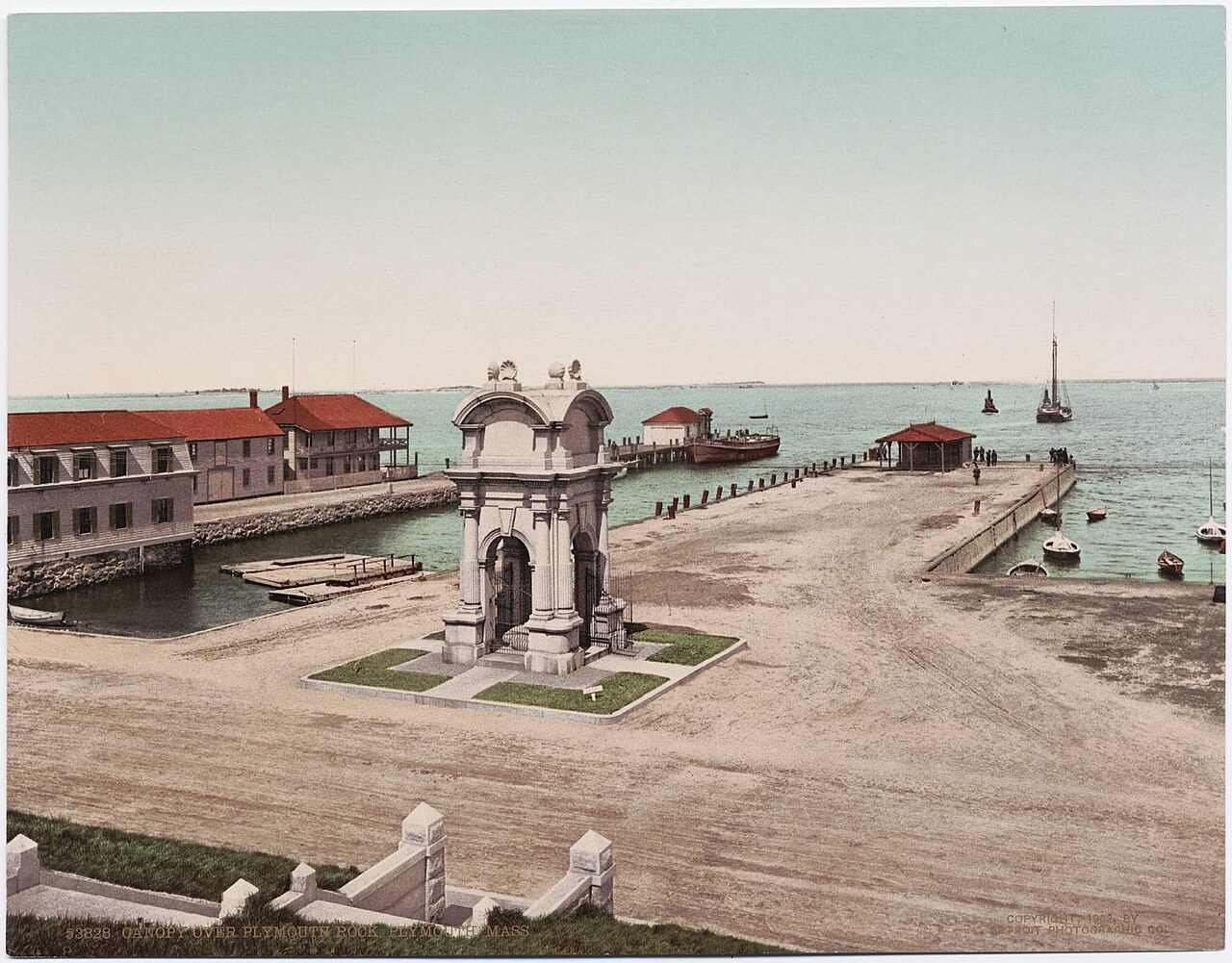
Then came the architecture. On July 4, 1834, the top half moved again, to the front lawn of Pilgrim Hall, inside an iron fence. In 1867 a granite canopy by Hammatt Billings went up over the bottom half, and a slice was cut off the base to make room. In 1880 the two halves were reunited under the canopy, and only then was "1620" cut into the stone. For the 300th anniversary, McKim, Mead & White replaced the canopy with a columned granite portico, dedicated in 1921. The rock sits in a bed of sand about five feet below street level.

The slice is the best part. The 400-pound piece cut off in 1867 spent years as the doorstep of the Harlow Old Fort House, until the Plymouth Antiquarian Society pulled it up in the 1980s and split it between the Smithsonian and Pilgrim Hall. Other chips became cufflinks, tie clips and walking-stick ornaments; Thoreau, visiting in 1851, noted that people chipped at it "till the town forbade it." A 40-pound piece at Plymouth Church in Brooklyn has a plaque: "The Door Stone of American Liberty."

What's left at the shore is maybe a third to half of the original: about four tons you can see and six more under the sand. In 1835 Tocqueville wrote that "this Rock has become an object of veneration in the United States." The first words out of plenty of first-time visitors, History.com reports, are "That's it?"