The Wagon and the Shirt
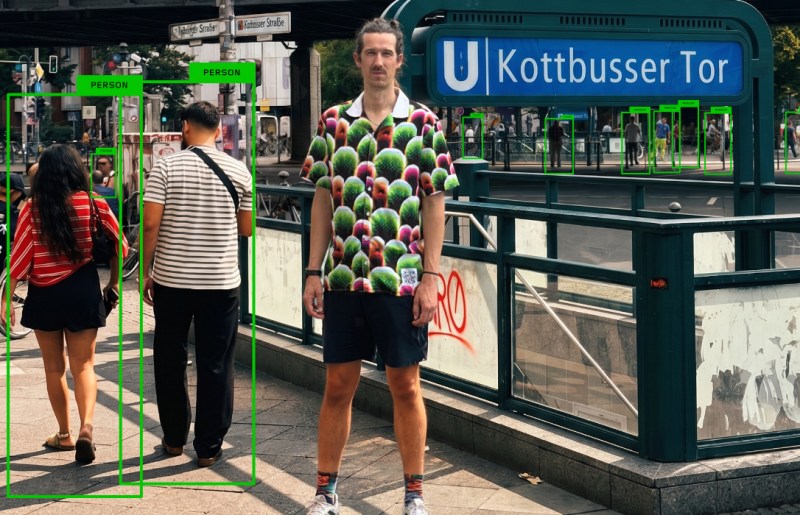
Same artist, same Berlin street corner, six years apart — one trick exposed how gullible an algorithm is. The other just started wearing it as armor.
Berlin turned on its first AI-monitored public square this month. Kottbusser Tor — one of the city's roughest transit hubs — now runs cameras feeding a system trained to flag "suspicious" movement in real time, legal since Berlin's public-order law was amended in December. Officials say it's not facial recognition, that people show up on screen as anonymous stick figures. It still has to see a person to flag one.
Simon Weckert's answer is a shirt. He calls it Digital Camouflage — a loud, tropical-looking print that's actually adversarial math, tuned against an open-source detection model (YOLO) until it stops reading "person" and reads static instead. There's a photo of him standing right under the Kottbusser Tor sign wearing it. Everyone around him in frame gets boxed and labeled PERSON. He doesn't.
Weckert did the opposite trick to the opposite kind of system, in the same city, six years earlier. In 2020 he loaded 99 second-hand phones into a little red wagon, opened Google Maps on all of them, and walked it down an empty Berlin street. The app read the signal cluster as a traffic jam and turned the street red on everyone's map, rerouting real drivers around a road with no cars on it. His line on it at the time: it "shows you how rudimentary these systems are."
That one was a joke played on a tech company. This one's a shield against a police department. Same move underneath — feed an algorithm exactly what it's built to misread, and it will misread it — just pointed at something with real teeth this time.
Even Weckert doesn't oversell it. No one outside government gets to test the actual Kottbusser Tor system, so the shirt is only verified against YOLO, a public stand-in. One reader who ran it against a different detector reported the shirt still got flagged as a person. Weckert's own description of the project fits either result: "a visible signal that being read by machines is not something everyone consents to."