“In the footsteps of pioneers William Higinbotham, Steve Russell and Ralph Baer, Nolan Bushnell is about to create an entire entertainment industry, which in a few short years will eclipse even the 80 year old movie business.”
Nolan Bushnell had a dream. He was 19 years old and he worked that summer as a manager at an arcade in a Salt Lake City amusement park and he loved playing Spacewar at the university’s mainframe.
[kml_flashembed movie="http://www.youtube.com/v/Rmvb4Hktv7U" width="425" height="350" wmode="transparent" /]
Nolan decided that he wanted to play Spacewar everywhere and started a quest called “Computer Space”. The game was a flop because it was very hard to play. You had buttons for everything….
[kml_flashembed movie="http://www.youtube.com/v/NFXf-RBMo3E" width="425" height="350" wmode="transparent" /]
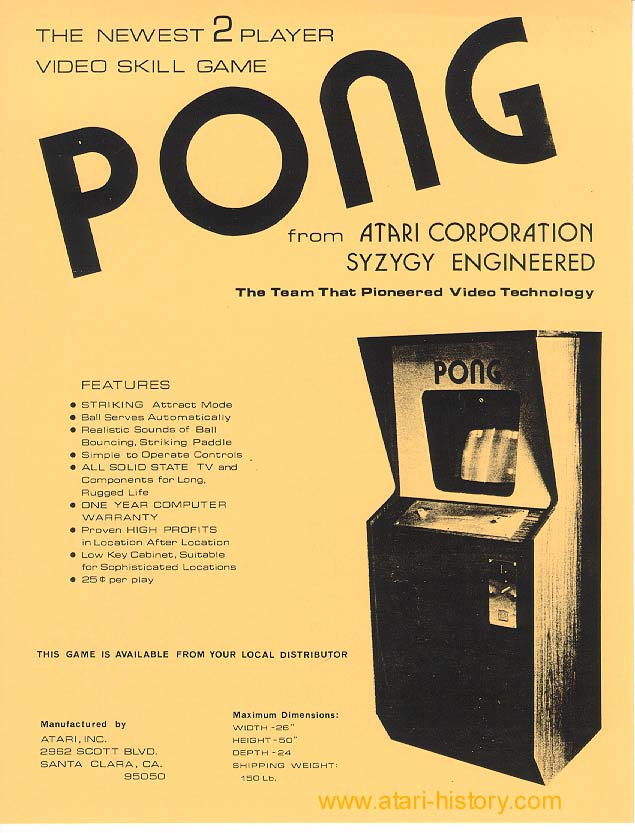
After that, Bushnell teamed up with Ted Dabney and with an investment of $500 ($250 each) started a new company called Syzygy, a term from astronomy meaning the Earth, Moon and Sun in perfect alignment. “Designed by Syzygy” actually appeared on labels on Computer Space.  Thankfully the name was already taken, so Bushnell picks a name from Go, a Japanese game he is fond of playing. Atari is the equivalent of “check” in the game, and that is the name they pick. The company is officially established on June 27, 1972, by a 27 year old Bushnell. The first product is to be a driving game, and Al Alcorn, the engineer Ampex had hired to replace Bushnell, is brought in to build it. But Bushnell changes his mind and decides that they should first break newcomer Alcorn in with a simplistic tennis game, where the player controls a paddle knocking a ball back and forth across the screen. Though Bushnell wants impossible-for-the-day sound effects like a roaring crowd, Alcorn pulls beeps and blips that are already present in the circuitry for the sound…and when Alcorn describes the noise of the ball hitting the paddles, he inadvertently names the game…PONG. The electronic guts are entirely solid-state and hardwired…no ROMs or microprocessors are present. This baby is made to do one thing and one thing only. Play PONG.
After much agonizing about the speed of the ball and how fast the spin-dial control moves the paddles, a prototype is made. The instructions for the world’s second arcade videogame are legendarily simple: “AVOID MISSING BALL FOR HIGH SCORE”.
[kml_flashembed movie="http://www.youtube.com/v/LPkUvfL8T1I" width="425" height="350" wmode="transparent" /]
The rest is history….to be told in another post. Martin wrote a good post about the passion behind videogames.
pol